
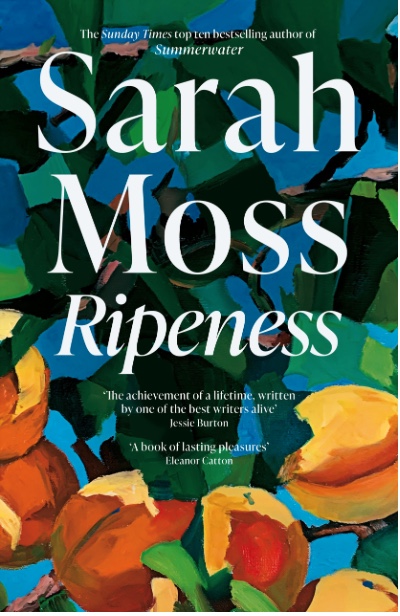
Ripeness, Sarah Moss
First published in the Newtown Review of Books
The first words of this novel are from a woman in bed with her lover, in a state of ecstasy, and it is not long before we realise that she is not a young woman. The woman is Edith, 73, seeking and finding pleasure with honesty and poignancy. It is a refreshing opening.
There are two strands – Edith today in rural Ireland, and her life in 1968, during a summer in a villa in the countryside in the north of Italy. Edith’s sister, Lydia, a ballerina, is expecting a baby and has been set up in the villa by her lover, a principal dancer in the company. Edith has finished school and been accepted at Oxford but, fluent in French and conversant in Italian, she has been temporarily rerouted by their mother to help. Edith is telling a story that she knows may never be read but one she needs to record. She addresses someone, warning them occasionally. ‘I’m wondering if you’d rather I told you a fairy tale, if it would help you to believe something other than the truth …’ In Italy, Edith is still a child, but over this summer, she will be forced to grow up.
In the villa, time slows. Edith finds tasks in the kitchen and the gardens, gradually earning the trust of the housekeeper, Signora Pilone, which helps her through the days. She explores the hills behind the villa but is increasingly loathe to be away for too long.
On, up, until there was nothing behind the hill rising in front of me, until I came out on the top and could see in every direction, across a sea of summits, over the other lake into Switzerland, hill calling to hill, a new country at altitude.
The two sisters have little in common. Lydia is prickly and sad, distressed about her future in dance after she has had the baby, but Edith has little knowledge of that world, or how to help with a pregnancy or birth. Lydia is also nursing a private pain which she shares with Edith finally. Her lover, Igor, does not appear at all.
When members of the ballet company come to visit, Edith watches them practise in the barn. Their soaring grace contrasts with Lydia’s literal confinement and Edith’s claustrophobia and anxiety about the impending birth. Like the dancers, Edith longs to be held, to be lifted. Signora Pilone asks, Where is their own mother? reminding her that she, too, is a child. This burden is too great.
Rachel, Lydia and Edith’s French mother, is a Holocaust survivor who escaped to England where she married a local farmer in order to stay, to survive. Edith grew up on the farm in England, raised mostly by her grandmother and father, her sister departing at 12 to ballet school. Rachel has mostly abandoned her daughters, and her husband.
Even married and settled, simulating being settled, it seemed unlikely that my mother had regarded babies with any enthusiasm. I would have gone out looking for them after the war, she said once, I would not have given up, only I was pregnant and it was not permitted. She meant looking for her parents and her sister, who had followed the order to board the trains to the camps.
Moss interrogates motherhood, which must be freely chosen and entered into, and even then, is not unalloyed. There is ambivalence. Edith is aware of her own ‘unfitness’ for motherhood.
Tie my tubes, she’d said after Pat was born, but even in London in the 1980s they wouldn’t do that for a healthy young married woman … She loved Pat in the animal way mothers love babies, barring disaster, but early childhood was boring …
The violent separation of mothers and babies, as occurred in the Holocaust and also in Ireland’s ‘laundries’ for unwed mothers, is a disturbing undercurrent. Men who rape, who impregnate women and enforce birth, are also present – further acts of violence.
Belonging is abandonment’s counterpoint. Edith’s friend Méabh has been contacted by a half-brother in America who, having just found his Irish family, wants to come ‘home’. Edith muses over her lack of acceptance as a local, despite having lived in Ireland for decades. If belonging is a shared history, what is his claim to it? He has been chosen, had a comfortable life, been loved – is that not enough? Her mother found belonging on a kibbutz in Israel. She needed others around her who understood her stories, her loss, but Edith recognises that ‘belonging’ can curtail freedom, and retains her otherness. Her house has no blinds, for one.
It’s just nicer to have some privacy, Dearbhla says, that’s all, and Edith thinks that privacy is a commodity only where there is belonging, that for the outsider whose neighbours already know her strangeness it is nicer to have sunlight.
Take time with this book. Sarah Moss writes prose mostly unregulated by punctuation and her long long paragraphs force a slowing. Ripeness will break your heart because Moss sees you – she sees the mothers, the women who love men, and sex, and their own strong bodies, the women who defend their space, and who choose their futures; and she sees those who cannot. Edith feels the sun on her face, the rock beneath her. Addressing her reader, she says, ‘You’ll belong by caring for people and place.’ She knows that this, our world and how we perceive it, our literal sense of it, is all we have; this is life, to be savoured.
Sarah Moss Ripeness Picador 2025 PB 304pp $34.99

