
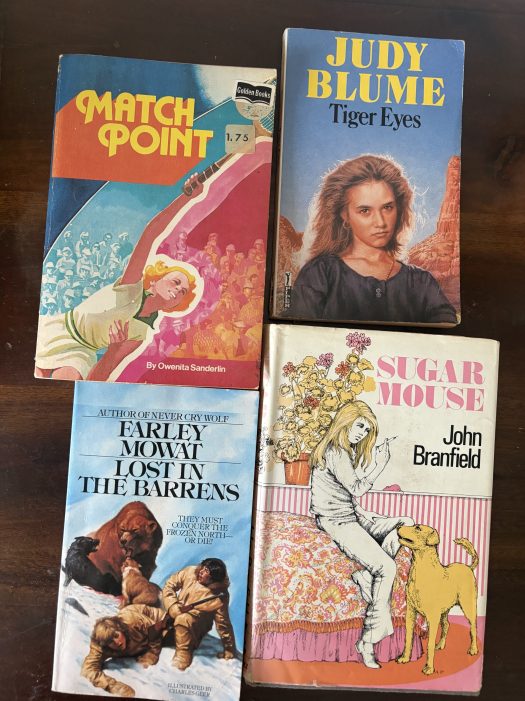
I lost all my childhood books. I don’t remember how it happened. I wasn’t paying attention. We moved around in my growing-up years, between houses and between countries. Boxes were packed, shipped, unpacked seamlessly every few years as I moved through childhood, adolescence and then teens. We didn’t cleave to things, or to places. ‘Nah,’ I would have said, if my parents had asked whether I wanted to keep them. Gen X never had Young Adult and perhaps that leap from Children’s straight into adult was another reason why I saw them as my past and left my books behind. When I was sixteen, I left home to finish school in Australia. Then, at eighteen, I moved to Sydney to university and into years of share houses, and then with my husband, and our own first and second homes. Books came with me in all these moves, but those of my childhood had melted away.
Growing up, I would trek down a muddy path in a rubbish-strewn, hilly ‘woods’ and along city streets to the local English library in Kowloon. I would borrow a stack, often taking out favourites to reread. My memory, slippery around so many things, holds whole tracts from these books, still. With my own children, I rediscovered the lure of the library. Propping them up on a cushion with the distractions of soft toys and picture books, I would disappear into the adult shelves until exasperated librarians would call me back. We moved to Colorado when my children were two, four and seven. There I found American public libraries: things of beauty. For a country that professes to despise socialism, they have a contrary and deeply-held belief in this institution.
In Denver, something rekindled. On my first visit, hopeful, nervous, I told the woman behind the desk that the supermarket loyalty program had turned down my Australian license. She looked at me kindly. We’re the Library. It had a children’s section bigger than the entire library at home and held my childhood in print—all the Green Gables books, the What Katy Did books, the Nancy Drews.
I began to look for some of the others I had loved—those less well-known, out-of-print.
Today, books are born digital: created, stored, edited, published, read. Born digital means easily found. When publishers decline to reprint, libraries don’t have space, and paper is destroyed, older books quietly fade away. I started to look in the digital repositories, virtual index card holders, of books held in participating second-hand stores.
There was one I had borrowed time and time again from that local library in Kowloon. Though I remembered its title, Sugar Mouse, I had no idea of the author. The search field came good—I could see copies in a few bookstores in New Zealand, its cover exactly as I remembered. When it arrived, bubble-wrapped, a ghost from my past, I sank into its slightly yellowed pages in wonder. It was as I remembered, but those parts I had forgotten spoke to me the most eloquently. I couldn’t save my brother who died when he was 35 and I thought my desire to save the world had started with his illness, but it dated from far earlier. As I turned the pages, I was reminded how Sarah rescues a dog from a mine shaft, and I remember being that child, reading this book.
Tiger Eyes I had stolen as a child from a place we were housesitting. I wonder if the girl whose room I borrowed for those days missed it. I’m sorry but I had to have it. The girl in the book is about 14. She has lost her father in a violent attack when she meets a mysterious boy who becomes her friend. He simply lets her be as she moves through profound grief in the weeks and months that follow. I had remembered its name and, when I searched, realised its author was Judy Blume. Though its story did not run parallel to my life, its themes of love and acceptance did. That is the power of good writing.
Match Point was another favourite. I remember buying it from Angus & Robertson, or Dymocks—a memory amplified by the displacement of being on holidays in Australia. I was a gangly kid who played lots of tennis and this book was about a girl my age who is determined, and feisty and talented. I wanted to be her. I wanted to win. I still do.
One more has recently arrived from Thrift Books, Dallas, and it has a strange resonance. The Telltale Summer of Tina C is another 12 year old girl. She lives somewhere in the tri-state area where she and her friends, the Saturday Sad Souls Club, meet to muse over their shortcomings. I know this girl. We have left behind our Lego, our Barbies, and crave something more. Her mother has left to live in New York City. ‘They’re not real’, she says to her daughter. She means the suburbs, the tennis clubs and swimming pools.Today, I, too, have left the suburbs, relocating to a city interstate for work for a period, taking a certain freedom which spoke to me years earlier.
Aged about 10, I closed the final pages of one book thinking, ‘That is the best book I have ever read.’ I remembered the author, Farley Mowatt, the Canadian naturalist and writer. Though now retitled Lost in the Barrens, I found it and read it to my own children. That wondrous tingling of imagination and satisfaction I had felt was sparked by this story of two boys, one Inuit, one Caucasian, who become separated from their party and must survive a winter alone in the deep north of Canada. When I read it as a child, I didn’t know that not too far into the future, I, too, would need to draw on reserves I didn’t know I had to survive.
A book that literally changed my life I cannot find. A passage within it rang out, sang clearly and sweetly, that this was life. I listened, and woke from a month of coma and semi-unconsciousness and amnesia. Suffering a severe head injury in a car accident in Australia, I was brought home to Hong Kong. I was close to surfacing, half-present, seemingly unaware of my surroundings but I knew where I was. I simply thought I was in a dream. I knew my parents and I knew the books on the shelves. I picked one out one evening. I liked this one, I thought. I’ll take a look again. And as I read, I realised that I was remembering scenes that I had forgotten. They came from a world that was real. A mother picks up her child in her dressing gown. ‘Mom!’ says the girl in outrage, ‘What if you’d gotten a flat tire?’ This was no dream. ‘This is real’, I said to my mother, ‘I’m in Hong Kong.’ ‘Yes’, she said, and wept. I had come back.
I remember bits and pieces of that book but not the title, nor the author. One day I might find it, and it might join those others on my shelves now that I have revived. All good literature can shake the earth, and those written on the cusp of childhood and something more speak to that period of deep yearning of things known and not known. These books taught me what it was to be a girl in the world, to be vulnerable, afraid, and to fight. These books are my scars.

